San Jose, CA · Answering 24/7
Storm drain cleaning and yard drainage in San Jose
Rain in San Jose arrives in a few months of storms, and when it comes, the water has to go somewhere. Downspouts that dump against the foundation, yard drains clogged with leaves and soil that holds water all push it toward the house. Storm drainage moves roof and yard water away, separate from the sewer.
Storm drain and yard drainage work in San Jose means clearing clogged storm lines and catch basins, running downspouts into buried drain lines, and installing French drains where water pools against the foundation. Storm drainage carries rainwater away from the house and stays separate from the sanitary sewer, where rainwater does not belong.
The job
Where the rainwater should go
Every roof and yard needs a path for rain. Gutters collect it, downspouts bring it down, and buried drain lines or surface channels carry it to the street or a dispersal point away from the house. When any part of that path clogs, or ends too close to the foundation, water collects in the crawl space, soaks walls and floors, or backs up at a patio drain during the first big storm.
Sewage coming up an indoor drain after rain is a different problem, covered under sewer backup emergency. Storm lines packed with silt and roots are often cleared with hydro jetting.
Cost factors
What changes the price of drainage work
- Length of run Longer lines cost more.
- What sits on top Pavers and concrete must be lifted and reset.
- Soil Clay ground needs larger trenches.
- Discharge point The outlet location sets the route.
- Existing lines Old buried lines may need clearing or replacing.
Every job is priced after we see it; any published range is for planning only.
Storm drain cleaning
Storm lines, catch basins and area drains collect leaves, silt and roots that slowly narrow them until the first heavy storm overwhelms them. We clear them with a cable or a water jetter, flush out the silt, and run a camera where a line keeps clogging to find a break or a sag. Catch basin grates and silt traps are cleaned out, and we check that the line actually discharges where it should, since a crushed outlet backs up the whole system.
French drain installation
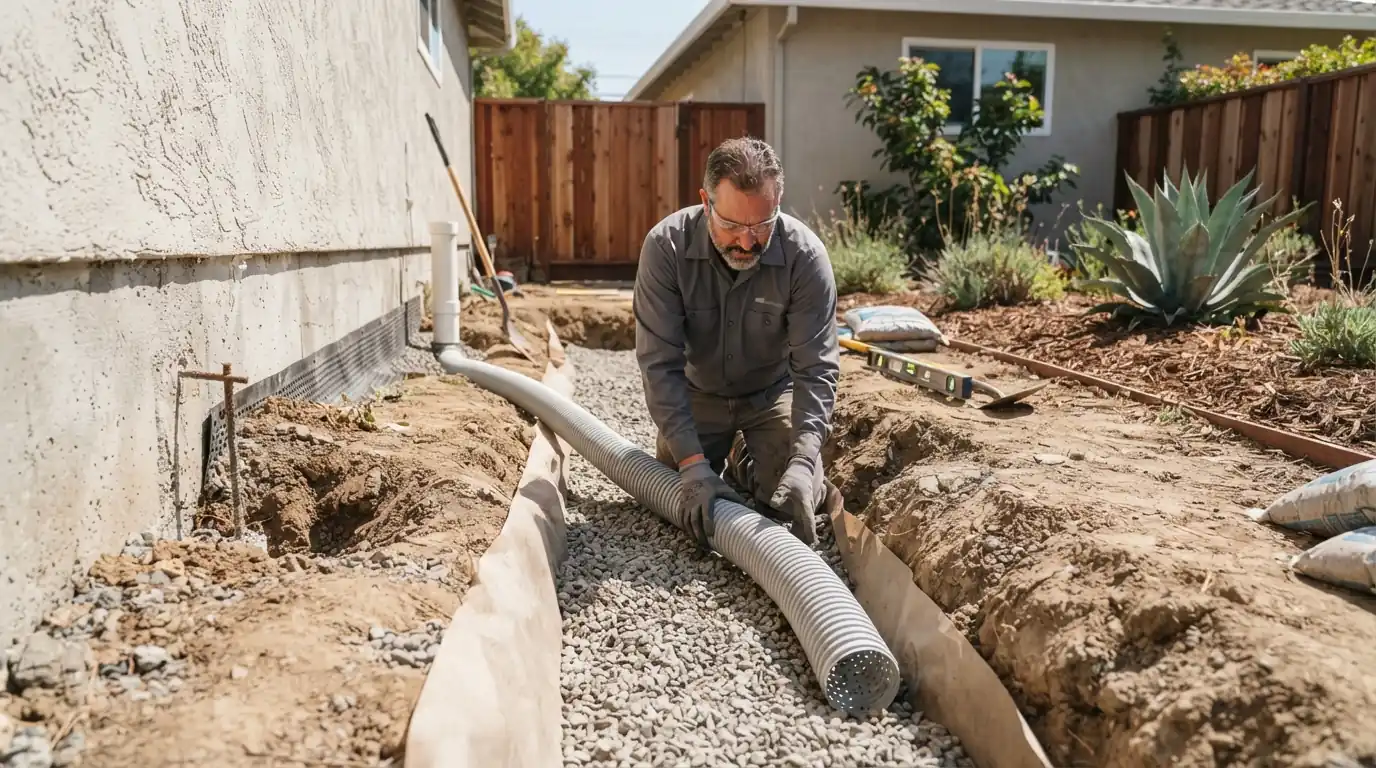
A French drain is a gravel-filled trench with a perforated pipe that collects water from saturated soil and carries it away. It suits yards where water pools against the foundation or a lawn stays soggy for days. We cut the trench along the problem area with a steady fall, line it with filter fabric so soil does not clog the gravel, and connect the pipe to a solid line running to an approved discharge point. In clay ground, the trench is sized for slow-draining soil.
Downspout drain lines
Downspouts that end at the base of a wall put the whole roof's runoff right beside the foundation. Connecting them to buried solid pipe carries that water away to the street, a dry well or another approved outlet. We size the pipe for the roof area it serves, add cleanouts where lines join, and slope every run so it does not hold standing water. Existing buried downspout lines are camera-checked and cleared before we tie into them, since an old line crushed by roots or a car tire will back up the new work.
Catch basin and channel drain
Low spots in a yard, patio or driveway need a surface drain to collect water before it reaches the house. A catch basin works at a single low point; a channel drain runs across a driveway or in front of a garage door. We set them at the correct height so water actually enters them, connect them to solid pipe with enough fall, and add a sediment trap so leaves and grit are easy to clean out before the next storm.
What happens after you call
How a drainage job runs
- 1
Walk the site
Where water comes from and pools.
- 2
Test
Water run through existing drains.
- 3
Camera
Clogged or broken lines located.
- 4
Plan
Route, fall and discharge point set.
- 5
Install or clear
Lines, basins or a French drain.
- 6
Water test
Flow confirmed before backfill.
Local context
Storm season in San Jose
In February 2017, days of heavy rain sent Coyote Creek over its banks, and about 14,000 San Jose residents were ordered from their homes; in the Rock Springs neighborhood, a sewage pumping station was knocked out of service. No yard drain protects a house from a creek flood. But storms like those show how much water a lot has to shed in a few hours, and the everyday version is water pooling against a foundation. Clearing drains before the rainy season keeps that water moving.
Timing
How long drainage work takes
Clearing a clogged storm line or catch basin is usually a single visit. New downspout lines and French drains depend on the length of the run, the soil, and what has to be lifted and replaced along the way, such as pavers or planting beds. The work is easiest to schedule before the rainy season; during a storm, the priority is getting water moving, and permanent work follows once the ground dries.
Warning signs
Signs your drainage is not keeping up
- Water pooling at the foundation
Downspouts or grading send it toward the house.
- Damp crawl space
Water getting under the house after storms.
- Patio drain overflowing
A clogged or undersized line.
- Soggy lawn for days
Soil that cannot drain on its own.
- Downspouts ending at the wall
Water dumped right beside the footing.
- Washed-out mulch or soil
Runoff concentrated in one spot.
- Water at the garage door
A channel drain clogged or missing.
FAQ
Storm drain and drainage questions
No; rainwater stays out of the sanitary sewer.
To the street, a dry well or another approved outlet.
It suits areas where water pools or soil stays saturated.
Before the rainy season, when the ground is dry.
Yes; we get water moving first and fix it properly after.
Yes, including grates and sediment traps.
Often, when the water comes from the yard or roof.
Related work
Other Drains & Sewer jobs we handle
Water pooling at your San Jose home?
Call any hour; we clear the drains and plan the fix.
Updated September 2026