San Jose, CA · Answering 24/7
Water softener installation in San Jose for valley-floor hard water
White crust on faucets, spotty glasses, a water heater that rumbles with sediment. On much of the valley floor that is groundwater hardness, and a softener sized to your water, with a bypass and a proper drain, takes most of it out.
A water softener in San Jose makes sense where the home is served by valley groundwater, which tests roughly 11 to 26 grains per gallon, well past the 7 grain line San Jose Water uses to define hard water. We test your supply, size the unit to your household, and plumb it at the main with a bypass.
The job
Sizing a softener to the water you actually have
Hardness here depends on which supply reaches your street, so the first step is a test at your tap, not a guess from a city average. That number, times your household's daily use, sets the grain capacity, and capacity decides how often the unit regenerates and how much salt it uses.
Softening protects what scale ruins fastest: water heater tanks, tankless heat exchangers, dishwasher valves and faucet cartridges. It does not change taste or remove chloramine; that is a separate job covered on our whole-house filtration page, and many homes here end up with both.
Cost factors
What decides the cost of a softener install
- Grain capacity Larger units cost more up front and are sized to hardness times daily use.
- Valve type Metered, demand-initiated valves cost more than timer valves and use less salt.
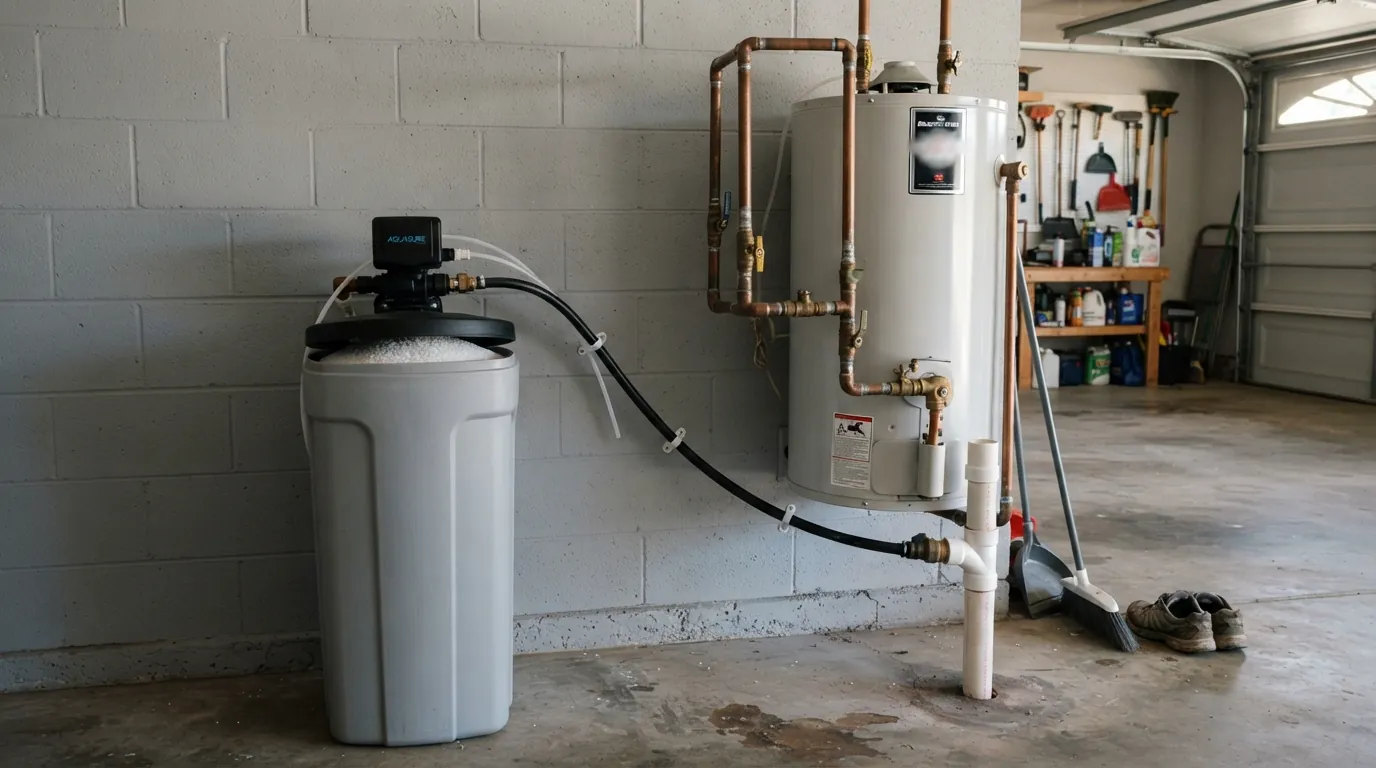
- Location and drain A garage install beside the laundry standpipe is simpler than a run to a new drain.
- Pipe at the tie-in Corroded galvanized at the main can add fittings or a short section of new pipe.
- Code items Air gap, bypass and any required permit are part of a correct install.
Every job is priced after we see it; any published range is for planning only.
Your options
Salt-based softener or a salt-free conditioner?
Both are sold for hard water, but they do different jobs. The choice depends on whether you want hardness removed or only scale reduced.
| Salt-based softener | Salt-free conditioner | |
|---|---|---|
| What it does | Removes calcium and magnesium | Reduces scale; hardness stays in the water |
| Spots and soap | Noticeably fewer spots, soap lathers more easily | Little change in spotting or lather |
| Upkeep | Salt refills | Media replaced on schedule |
| Drain connection | Needed for regeneration | Not needed |
| Best fit | Very hard groundwater, tankless heaters | Moderate hardness, no nearby drain |
Salt softener sizing
A softener that is too small regenerates constantly, wastes salt and water, and lets hard water through at the end of each cycle. One that is too large can sit so long between cycles that the resin bed channels. We size from three numbers: measured hardness, the number of people, and peak flow, so a shower and the washer running together do not pull hardness through. The control valve is set to regenerate on metered use rather than a fixed day, which ties salt use to what the house actually draws.
Bypass loop plumbing
Every softener we set gets a three-valve bypass or the maker's bypass valve, so the unit can be isolated for service without shutting water to the house. Outdoor hose bibs and irrigation stay on hard water where the layout allows; there is no reason to soften water for a lawn. On homes with galvanized mains we check the pipe at the tie-in point, because cutting into corroded galvanized is where a simple install can turn into a pipe leak repair.
Drain and brine line
Regeneration flushes brine to a drain, and code requires an air gap so wastewater cannot siphon back into the unit. Garage installs usually discharge to the laundry standpipe or a floor sink; where neither is close, we run a dedicated line. The brine tank overflow gets its own route as well. A drain line that kinks or pulls out of the standpipe is the most common reason a softener floods a garage, so we secure it along its full length and run a manual regeneration before we leave.
Softener replacement
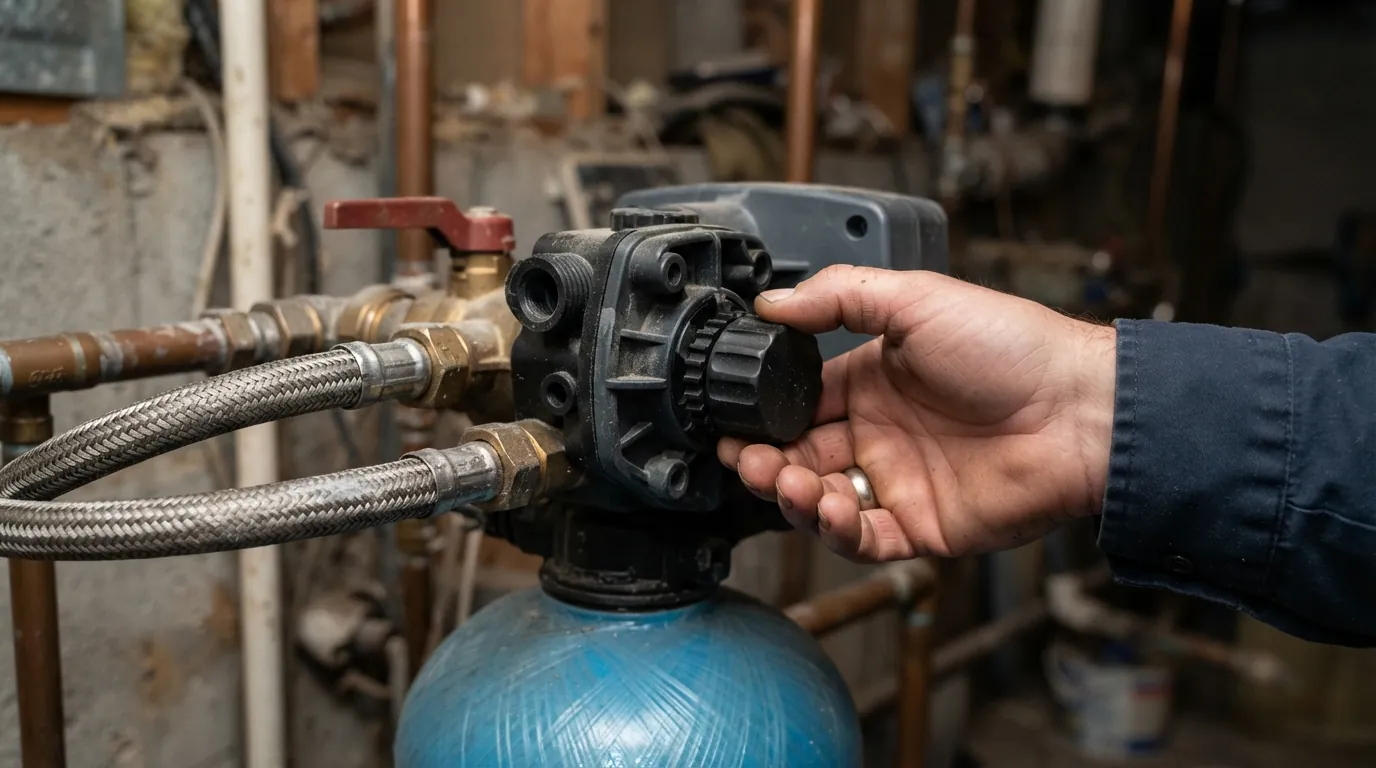
Older units fail in predictable ways: a control valve that no longer holds its program, resin that has broken down so hardness comes through, or a brine tank where salt bridges and stops dissolving. If the resin is the problem and the valve is sound, a rebed can cost less than a new unit; if the valve is obsolete, we replace the head or the whole system. We remove the old unit, reuse the bypass where it is in good shape, and set the new valve to your measured hardness.
What is included
What a softener install includes
- Hardness test at the tap
- Sizing to household use and peak flow
- Mounting on a level base
- Bypass valve for service isolation
- Tie-in at the main with new fittings
- Drain line with a code air gap
- Brine tank overflow routed to drain
- Control valve programmed for metered regeneration
- Test regeneration and a hardness recheck
What happens after you call
From water test to first regeneration
- 1
Call to book
We book a visit to test the water and look at the main.
- 2
Test and measure
Hardness at the tap, pressure, household size and peak flow.
- 3
Recommend a size
Capacity, valve and price before any work.
- 4
Install and tie in
Unit mounted, bypass plumbed, drain and overflow run.
- 5
Program and regenerate
Hardness and metered regeneration set, then a test cycle.
- 6
Recheck hardness
Softened water tested at a faucet.
Local context
Why two San Jose homes can need different softeners
San Jose Water treats anything above 7 grains per gallon as hard, and the supply map matters more than any city average: groundwater serving much of the valley floor tests around 11 to 26 grains, while imported surface water runs closer to 4.5 to 9. That spread is why we test at the tap before sizing anything. A home on groundwater and a home a few miles away on surface water can need very different units, or one of them none at all.
Brands we service and install
FAQ
What callers usually ask first
Test the water at a tap. Anything over 7 grains per gallon counts as hard.
Correctly softened water does not harm copper or PEX.
Most homes soften everything indoors and add reverse osmosis at the kitchen tap.
It depends on hardness and use; a metered valve keeps salt in line with demand.
Yes, if shaded and protected, though a garage install near a drain is simpler.
Yes. Softened water cuts how often a tankless unit needs descaling.
Yes, including Fleck-valve systems and Culligan units. We repair valves, rebed resin and fix drain and brine problems.
Related work
Other Pipes, Water & Gas jobs we handle
Guide: Hard water in San Jose.
Talk to a plumber about hard water in San Jose
Call any hour to book a water test and a sizing visit.
Updated September 2026