San Jose, CA · Answering 24/7
Gas line repair in San Jose, tested before the gas goes back on
A faint rotten-egg smell near the range, a hiss at the meter, a flex connector behind the dryer that has never been changed. A gas leak gets the utility first, then a plumber to repair the line, pressure-test it and bring the appliances back.
Gas line repair in San Jose starts with safety: if you smell gas, leave the house and call PG&E or 911 from outside. Once the area is safe, we find the leak, replace the failed pipe, union or connector, and pressure-test the system before any appliance is relit.
Warning signs
Signs of a gas leak around the house
- Rotten-egg smell
The odorant added to natural gas. Leave, then call.
- Hissing near a line
A leak large enough to hear.
- Dead plants over a buried line
Gas in the soil kills the roots above it.
- Bubbles in wet ground
Gas escaping from a buried run.
- Pilot keeps going out
Can point to a supply problem at the appliance.
- Higher bill, same use
A small leak running all month.
- Yellow burner flame
Poor combustion; have the appliance checked.
What happens after you call
From a gas smell to appliances back on
- 1
Leave and call the utility
Get out first, then call from outside.
- 2
Call us
Once it is safe, dispatch books the repair.
- 3
Find the leak
Detector and soap test along the branch.
- 4
Replace the failed part
Pipe, union, valve or connector, correctly fitted.
- 5
Pressure-test
The system is tested before gas returns.
- 6
Relight and check
Appliances relit and burners checked.
The job
What fails in household gas piping
Most household gas leaks are at connections, not in the middle of a pipe: an old appliance connector, a union loosened by a shake or a remodel, a valve whose packing has dried out. Corroded black iron is the other common failure, usually where pipe runs outdoors, through a damp crawl space, or in contact with soil it was never meant to touch.
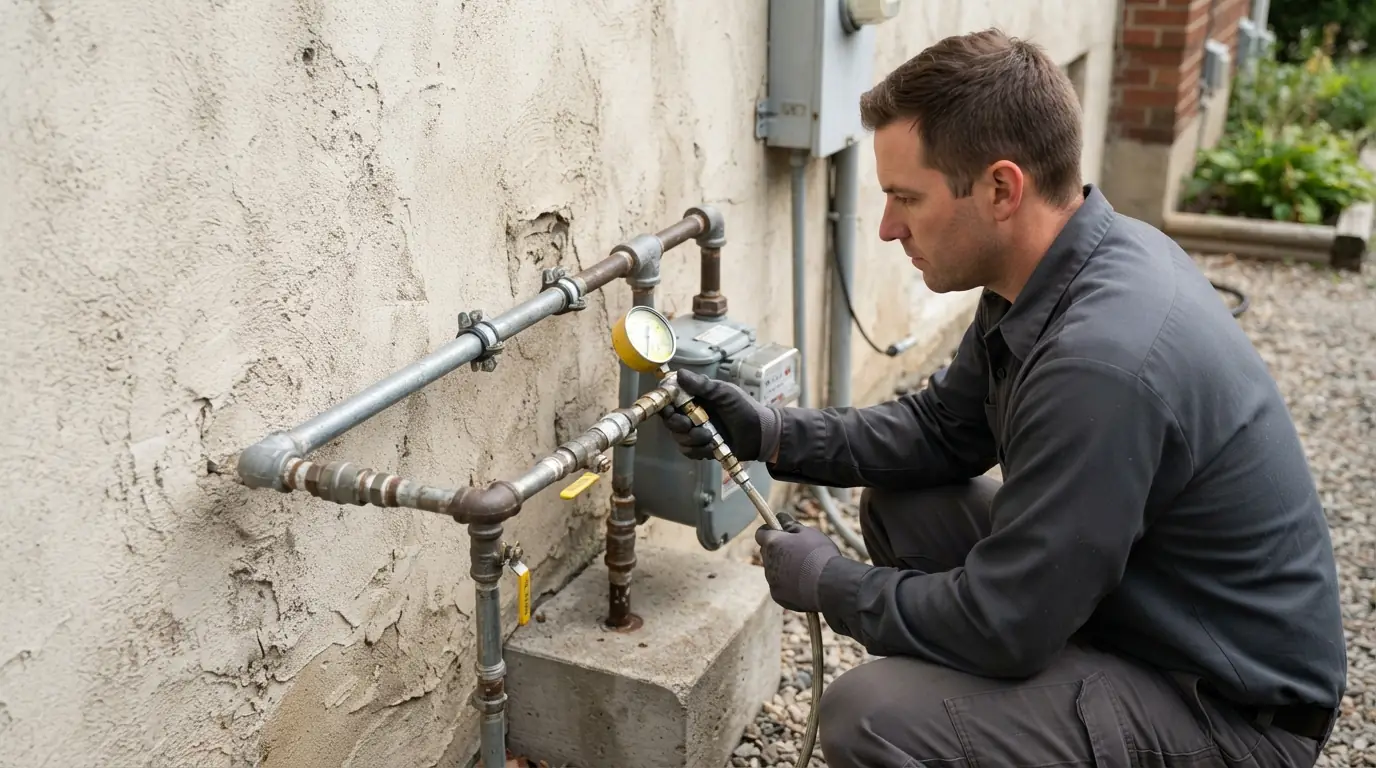
Repair means replacing the failed piece with the correct fitting, then testing the whole system under pressure, not just soaping the one joint. New runs for appliances are a different job, covered on our gas line installation page.
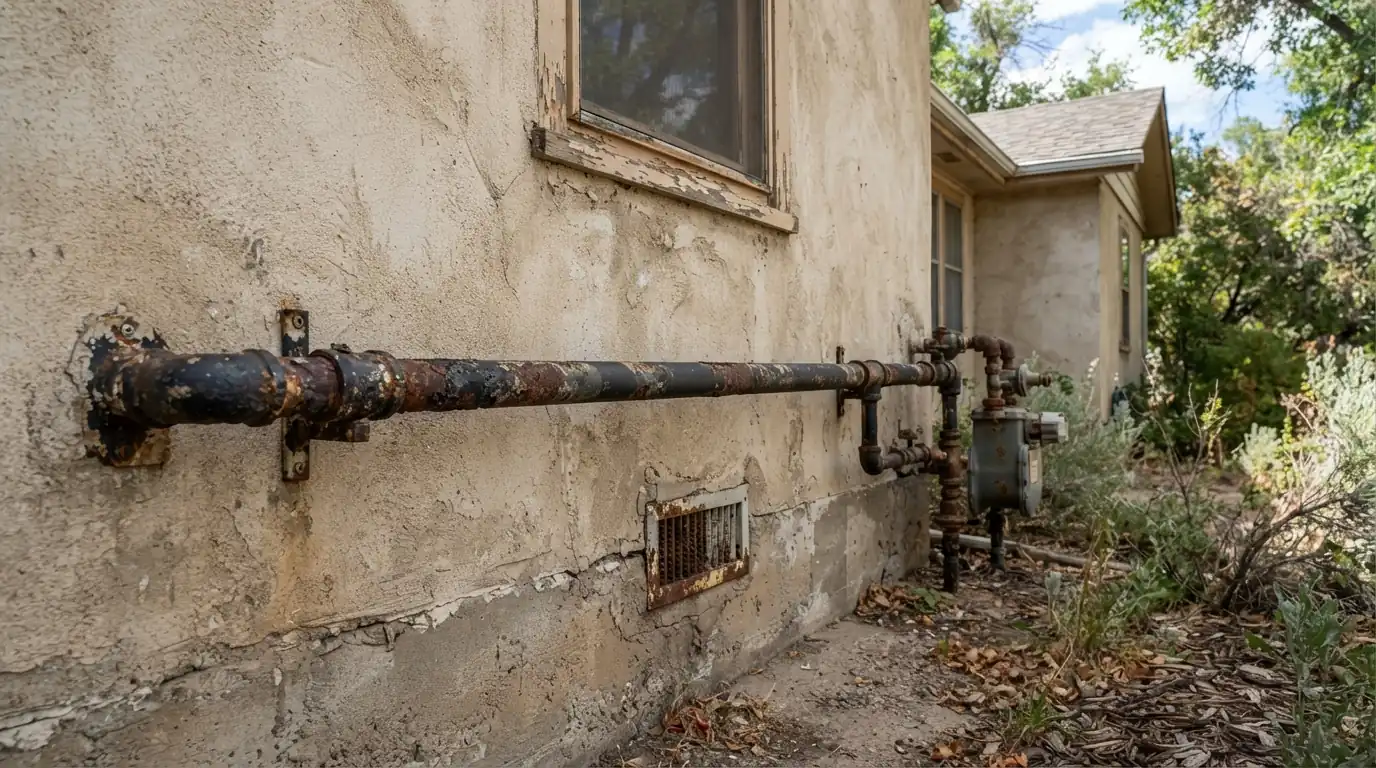
Corroded black iron
Black iron gas pipe is not built for moisture. Where it runs along an exterior wall, sits in a wet crawl space, or has been buried without a proper coating, rust works from the outside in until the wall thins into pinholes. We replace the corroded run rather than wrapping it, use coated or rated pipe where it passes through damp or buried spots, and support it off the soil. Replacing gas piping usually needs a permit, and the new section is pressure-tested before the gas is restored.
Failed flex connector
The flexible connector behind a range, dryer or water heater is the most-moved piece of gas piping in a house. Old uncoated brass connectors, common in homes from before the 1980s, can crack at the flare nuts, and the Consumer Product Safety Commission has warned about them for decades. Any connector that is kinked, corroded, pushed through a cabinet wall or older than the appliance it feeds should be replaced with a new coated stainless connector and a shutoff valve at the appliance.
Leaking union or valve
Unions and appliance shutoff valves are the joints most likely to loosen when a house shakes, settles or gets remodeled. A small leak here often shows up as an occasional smell near the water heater or furnace rather than a constant one. We find it with a detector and a soap test, then replace the union or valve rather than tightening an old joint that has already moved once. If there is no seismic valve at the meter yet, ask about an earthquake gas shutoff valve.
Meter-to-house line
The utility's responsibility ends at the meter; the pipe from the meter outlet to the house and every appliance belongs to the owner. A leak on that section, often a corroded riser or a buried run out to a detached garage, is ours to repair. If the utility has shut the meter and tagged the system, we repair the line and pressure-test it, then you call the utility to restore service, and we can come back to relight and check every appliance on the branch.
Timing
How long the gas stays off
A connector or valve replacement usually has the gas back on within the visit, once the pressure test holds. Replacing a corroded run takes longer and can need an inspection before the utility restores service, so heat, hot water and cooking may be off for longer. We tell you which kind of repair it is before starting, so you can plan around it.
Local context
San Jose gas piping after 50 years
Most of San Jose's single-family homes were built between 1950 and 1975, so a large share of the city's household gas piping is now more than 50 years old. At that age the pipe inside the walls is often still sound, but connectors, unions and exposed exterior runs have had decades of moisture and movement. That is why a gas repair here always includes a look at the rest of the branch, not only the joint that leaked.
Ready when you are
Smell gas? Get out first.
Call the utility from outside, then call us any hour for the repair.
Cost factors
What decides the cost of a gas repair
Planning range, not a quote: $140 to $220 per hour for plumbers in Santa Clara County. Source: proplumbersanjose.com, 2026-07-26.
- What failed A connector or valve is small; a corroded run is more.
- Where it runs Crawl spaces, walls and buried lines take longer to reach.
- Permit and test Replaced pipe is pressure-tested; some repairs need an inspection.
- Appliance relights Each appliance is relit and checked after the gas returns.
- Time of the call After-hours work is billed differently; you hear how first.
Every job is priced after we see it; any published range is for planning only.
FAQ
Gas line questions, answered plainly
Leave the house, then call the gas utility or 911 from outside. Do not use switches inside.
The utility handles the meter and its supply. Piping after the meter belongs to the owner.
No. A disconnected, kinked or old connector should be replaced.
Replacing sections of pipe usually does; we tell you before starting.
The system is pressurized and held on a gauge to prove it is tight.
Yes. Every appliance on the repaired branch is relit and checked.
Yes. They close the gas automatically in a strong shake.
Related work
Other Pipes, Water & Gas jobs we handle
Gas line repair in San Jose, any hour
Once the utility has made it safe, call and dispatch books the repair.
Updated September 2026