Plumbing guide · San Jose, CA
Tankless or tank water heater? How to choose for a San Jose home
When a water heater fails, the replacement decision usually gets made in a day. This guide lays out the real differences, including the ones that only show up after install, like gas line size and descaling in hard water.
By Earl Newcomb, Plumbing Guides Editor · Updated September 2026
For most San Jose homes, a tank water heater is the cheaper, simpler replacement, while a tankless unit costs more up front but delivers continuous hot water. National guides put tank installs at $800 to $2,500 and tankless at $1,500 to $4,500, before any gas line upsizing the tankless unit may need.
How each one heats water
A tank heater keeps 40 or 50 gallons hot all day, ready to use, and reheats as you draw it down. When the stored hot water runs out, you wait for the tank to recover. A tankless heater stores nothing: it fires a large burner the moment a tap opens and heats water as it passes through a narrow heat exchanger. It never runs out, but it can only heat so many gallons per minute at once.
That difference drives everything else. A tank is sized by how much hot water you use in a burst, a tankless unit by how many fixtures run at the same time. Two showers and a dishwasher together is a common sizing target for a family home.
What each costs to install
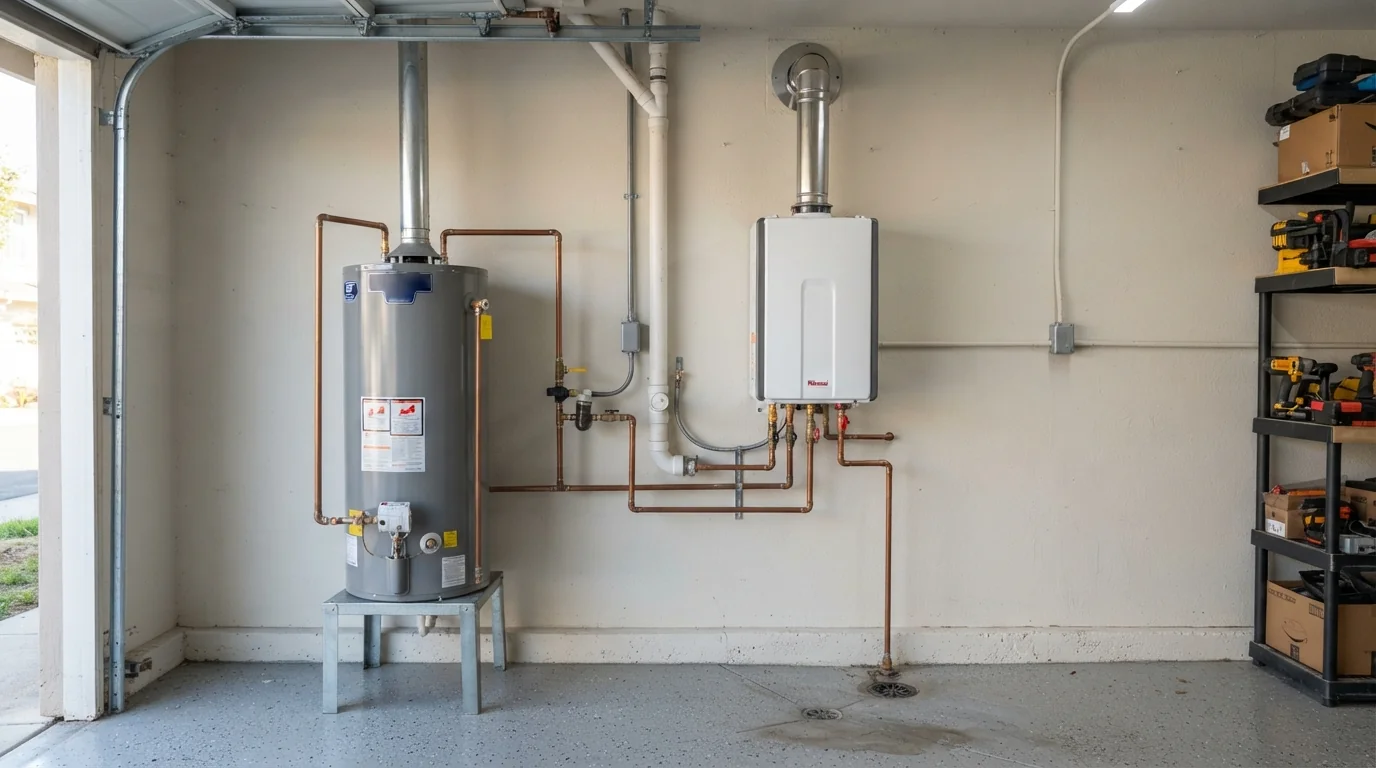
National guides put a new tank heater at roughly $800 to $2,500 installed, and a tankless unit at $1,500 to $4,500. The tankless figure often leaves out the work around the unit. A whole-house tankless heater can draw several times the gas of the tank it replaces, so the gas line is frequently upsized. It needs new venting, a condensate drain on condensing models, a 120V outlet, and isolation valves for servicing.
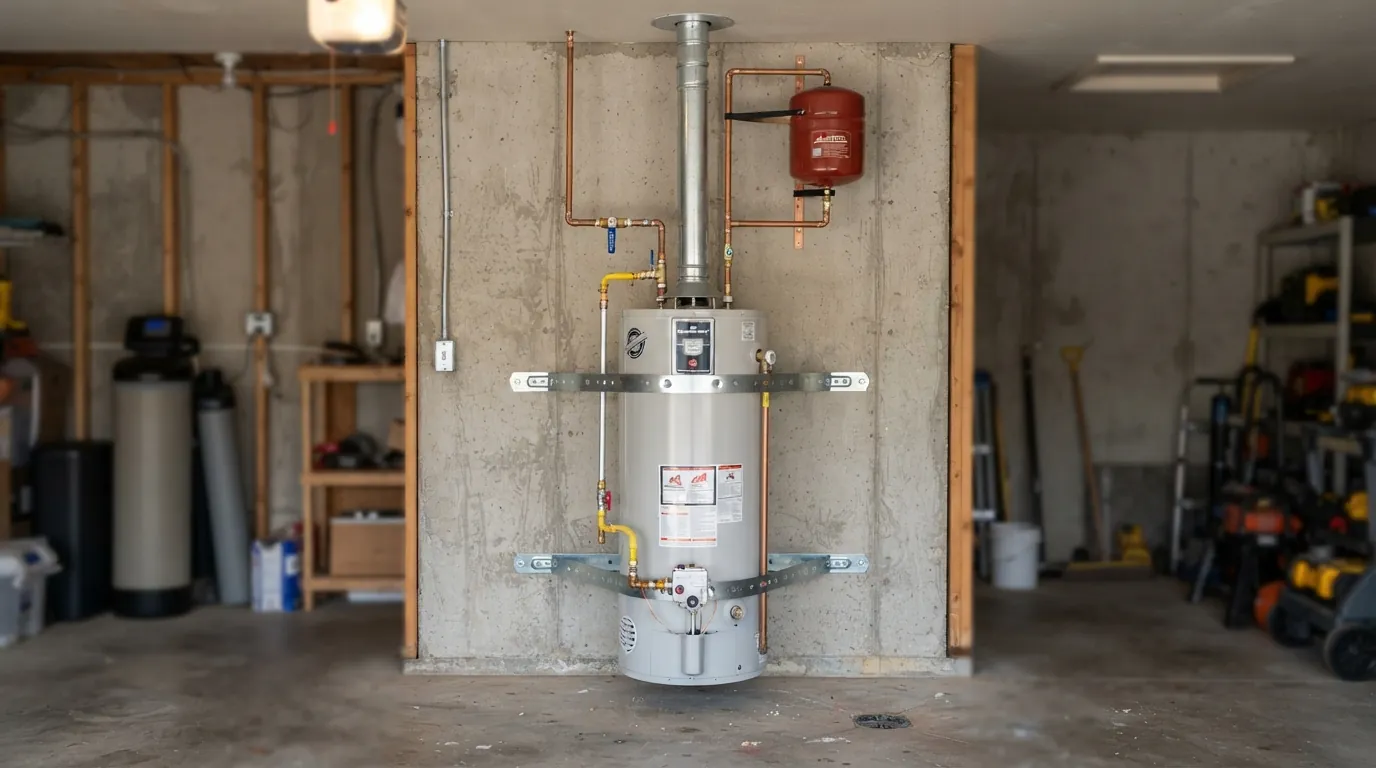
A like-for-like tank replacement reuses the existing gas line, vent and water connections, with code items such as seismic straps and an expansion tank. That is why the price gap between the two is usually wider in practice than the equipment prices suggest. Our water heater replacement page covers the straight swap.
Hard water and upkeep
San Jose water counts as hard, running roughly 10 to 16 grains per gallon depending on the blend, and groundwater on parts of the valley floor tests higher still. Both heater types feel it. In a tank, minerals settle as sediment on the bottom, the burner works harder, and the anode rod wears out sooner. In a tankless unit, scale builds inside the heat exchanger, flow drops, and error codes follow.
The difference is how the upkeep works. A tankless unit needs a descaling flush through its isolation valves, which makers generally call for yearly in hard water; a local guide puts an annual water heater flush at roughly $150 to $250. A tank benefits from flushing and anode checks too, but it tolerates neglect longer before it fails. A softener ahead of either one slows the damage.
Ready when you are
Heater failing and not sure what to replace it with?
Call any hour. We look at your gas line and household before recommending either.
Which households each suits
Tankless tends to suit households that run several showers back to back, homes where the tank closet space is wanted for something else, and anyone who has run out of hot water with guests staying. It also pairs well with hot water recirculation, which shortens the wait at far bathrooms.
A tank tends to suit smaller households, homes where the gas line would need a costly upgrade, and owners who want the simplest possible replacement when the old unit fails. Neither is the right answer for every house, and anyone who tells you otherwise without looking at your gas line and your household is guessing.
When a heat pump tank is the third option
Heat pump water heaters are tanks that heat with electricity by moving heat out of the surrounding air. They need a dedicated circuit, usually 240V, space with enough air around them, and a condensate drain. They are quieter than a furnace but not silent, and they recover more slowly in heat pump mode, with an electric element as backup.
For homes moving away from gas, or where rebates are available, they are worth considering alongside the other two. Our heat pump water heater page explains the space and power checks.
Questions to ask before you choose
- How many hot water fixtures run at once in your busiest hour?
- Can the existing gas line carry a tankless unit, and if not, what does upsizing involve?
- Where would the unit and its vent go?
- How hard is the water at your tap, and who will do the yearly flush?
- How long is the wait for hot water at the farthest bathroom?
Answer those, and the choice usually makes itself.
Cost figures on this page are planning ranges from published guides, not quotes: plumbingpriceguide.com (2026); plumbingpriceguide.com (2026); plumbingpriceguide.com (2026-05-26). Every job is priced after we see it.
Related services
Where this guide leads
More guides: Galvanized pipes and repiping, Hard water in San Jose, Sewer backup: what to do first.
FAQ
Questions readers ask
It heats continuously, but only up to its flow rating, so size it for the fixtures you run at once.
Yes, with yearly descaling or a softener; without either, scale shortens its life.
Often. A whole-house tankless unit burns far more gas at full fire than a tank.
A like-for-like tank swap; tankless conversions add gas and venting work.
Well-maintained tankless units are generally expected to outlast tanks, but maintenance decides it.
Choose your next water heater with a plumber
Call any hour to book a visit that checks gas, venting and household demand.
Updated September 2026